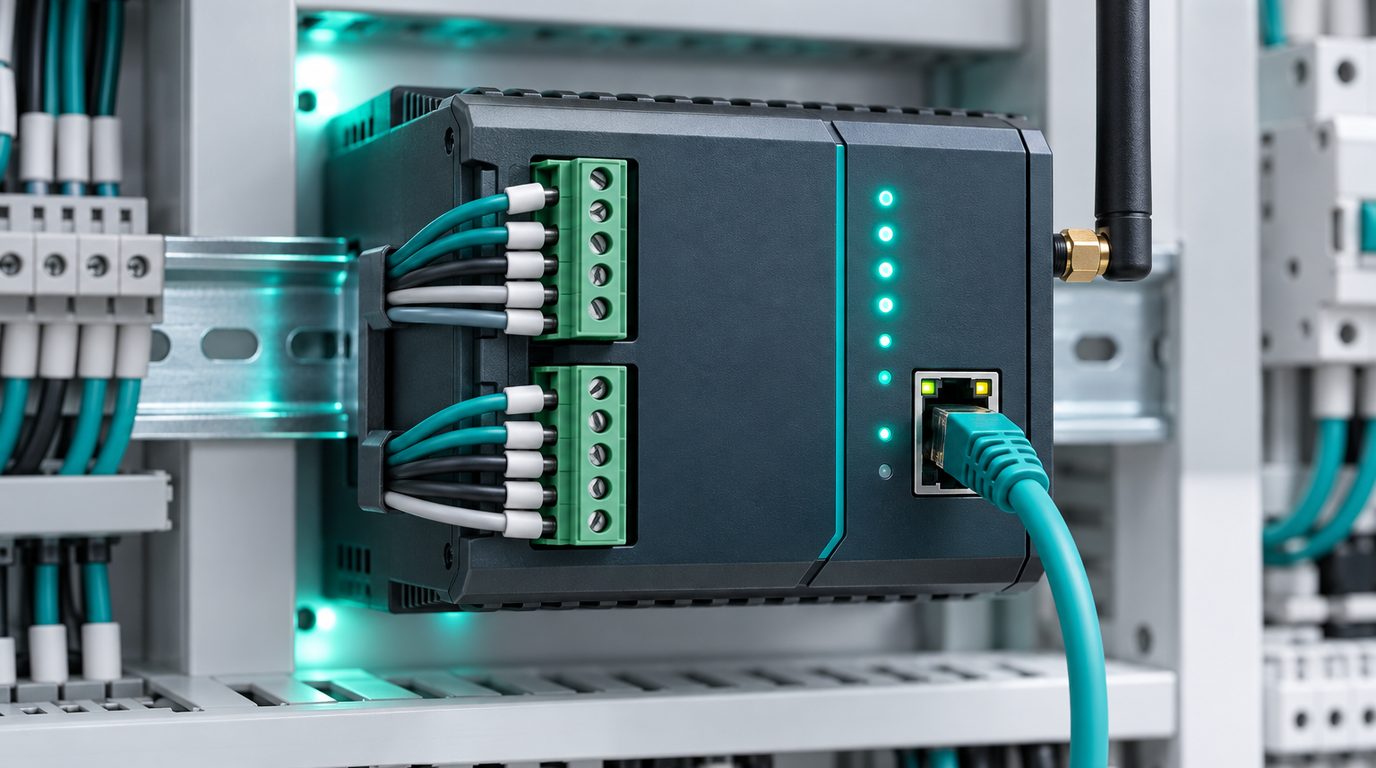
The registers are identical in both. Choose by the network you have: RS-485 wiring for RTU, an Ethernet port on port 502 for TCP.
Same Data Model, Different Transport
Modbus RTU and Modbus TCP expose the same four tables: coils, discrete inputs, input registers and holding registers. RTU sends compact binary frames with a CRC over a serial line. TCP carries the same function request in a TCP packet on Ethernet, without the CRC and with a unit ID in place of the slave address, normally on port 502.
Wiring RS-485 for RTU
RTU runs on a shared two-wire RS-485 bus. Daisy-chain the devices rather than wiring a star, terminate the two ends of the trunk, and give every device a unique address, normally 1 to 247. Set the same baud rate and parity on every device, such as 9600 or 19200 baud.
Ethernet and TCP
Modbus TCP devices connect to a network switch and answer on port 502. A TCP server may allow only a limited number of simultaneous connections, so plan which system polls each device. A Modbus TCP gateway can present serial devices on the network, usually identifying each by a unit ID.
Speed and Polling
A serial trunk is shared and slow, so request contiguous registers in as few requests as possible and keep poll intervals sensible. Ethernet is faster and handles more devices, but the device itself may still limit how quickly it can answer.
Choosing Between Them
Use TCP where the device has an Ethernet port and the network is available. Use RTU for older equipment and long runs between meters, and bring it onto the network through a serial gateway. Many sites use both.
Common Questions
What is the maximum number of Modbus RTU devices on one bus?
The protocol addresses devices 1 to 247 on one serial line, but the practical number is lower. RS-485 transceiver loading, cable length, baud rate and polling time all limit it, so large trunks are usually split. Check each device datasheet for its unit load.
Do I need a gateway to read Modbus RTU over a network?
Yes, unless the device has an Ethernet port. A serial gateway connects to the RS-485 trunk and presents the devices on the network, either as Modbus TCP or through a polling platform. Place it on the bus and give every device a unique address.